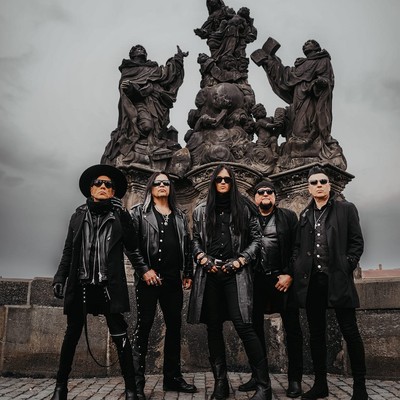
Jyrki: Sorry for being late, I was just doing another interview and it took a little longer than I expected.
Fess: It's all right. I'm glad to have you live; it's a big pleasure for me to have a talk with you. And I'm glad to hear that your new album is coming up soon. By the way, how soon will it be finished?
Jyrki: Well, actually, at the moment we are in the middle of recording it. It will be ready maybe by midsummer, and it comes out in October. And I mean — it's going to be fucking cool, of course. The new single will come out at the beginning of June.
Fess: Great, and what about the new album? Will it be similar to the old 69 Eyes style, or will it be something completely new — new sound or new ideas?
Jyrki: You know, we got signed — like, at the end of the year we got signed to a big major label, EMI and Virgin Records. Before that we were on small record labels, and now we are on a big-big major label, and that means they put a lot of, you know, power into making this record. So in that sense we've got all the best possible ways to make the record. We've done the preproduction and some arrangements with Johnny Lee Michaels, who has produced two earlier 69 Eyes albums ("Blessed Be" and "Paris Kills"), so now we've worked with him on the songs at the earlier stage. And the rest of the record and the overall producing is by Hiili Hiilesmaa, whom you might know from producing the HIM albums and Moonspell. So now we've got the best possible guys to take care of producing the record, which is just really important. And naturally we've been writing the songs for over a year, so now we have really-really extremely cool songs, and the concept of the album is going to be... I'm really excited about it. So things are going to be really cool. The thing is, "Paris Kills" was a really soft record with a lot of synthesizers, because we wanted it that way — we were really inspired by the '80s, you know, dark-pop scene, that kind of stuff, and that's why the record is what it is. But now we have fewer synthesizers this time, of course, because we want to make more, you know, albums that rock.
Fess: Actually that was my next question. It was about the sound of "Paris Kills" — it's not as hard as "Blessed Be," it sounds softer.
Jyrki: Yeah, it was on purpose, it was like what it is, and I really like it, and I think that's our best record. But now we want to... especially because we released "Framed in Blood (The Very Blessed of the 69 Eyes)," this compilation at the end of last year in Finland. So we toured in Finland for it and we played this old-school 69 Eyes stuff in the sets too, and it was really cool to play this old stuff for audiences who may have never heard it live in the mid-'90s when we last played this stuff. So that was a really rocky, rock'n'roll tour, and we want to keep the same energy, put the same energy back into the record. And as I said, we've done the preproduction with Johnny Lee Michaels, but because now we have Hiili Hiilesmaa as top producer, he makes sure that there's more raw edge, and you know, more of the sound of the band on the album. So that's something he brings to it. When someone asks how the new songs and new stuff will sound, we've been saying that it's like skull-rock, you know — the skull-y fest like the Misfits or whatever, and horror-punk-rock, all this stuff. I've also been listening to a lot of old '50s rock'n'roll and psychobilly and rockabilly to get — not the sound, you know — but the energy and the driving force. So, I mean, there are a lot of things I can say. There's a real string orchestra for the first time ever and things like that on the album, but don't worry, it's not like it sounds: it has the softer side, but it also has fucking dark things and the raw edge. So it's going to be amazing — I know it's going to be an amazing record. I'm super excited all the time about it.
Fess: I noticed that you have a lot in common with HIM (with Ville Valo, Hiili Hiilesmaa). Can we expect any joint projects?
Jyrki: They are really busy at the moment. I actually saw HIM about two months ago in Vienna, I went to see the show, it was great. But we are friends, they are touring in the States, and I think we are pretty busy at the moment in our own areas. So I don't think there's anything going to happen. In any case, we haven't planned anything yet. So no news about that.
Fess: Not so long ago you had a concert in russia. Did you like the country? How are the russian people?
Jyrki: Well, it was really cool, really nice. A pleasant experience — visiting russia. And we are very excited about coming back, because as far as I know by now — I hope these plans will come true — when we release the new album in October, I think we will come to russia before anywhere else. That's how the management has planned it for now.
Fess: You're called a Goth'n'Roll band. What is the meaning of the word "gothic" for you? What place does it take in the band?
Jyrki: You know, gothic is not a... of course we can talk about this for hours or a couple of days or weeks. It's not like a style or the way you sing, or the way you put keyboards in your song. It's more like a lifestyle, it's a way of how you see things. The difference is: gothic people see things as beautiful that people who are not part of gothic culture would wonder, "What's so beautiful about forests, about a cemetery...?" I use my gothic vision — see the world through my sunglasses in a gothic way — just to make your ordinary life and normal days more interesting. For instance: when it's raining it's not cool, probably, but you can always think, "Wow! This is gothic weather! Why not?" I think gothic is about how you see and live your life — pretty much romanticizing everything and using your imagination to make your life more interesting, make it more fantasy-like in many ways. And along with that, there's gothic culture, which is so huge these days that it has so many different kinds of music styles and ways. But what brings gothic people together is how they see things, how they enjoy certain things, and definitely, of course, some movies, some bands. But for us... in Finland where we are pretty much a mainstream band, selling platinum amounts of records, we're in teenage pop magazines — I think the guys who are "true gothic people," as they want to call themselves, don't see us that way. But like you said, we are a Goth'n'Roll band. So whatever — it's always like that. When your older sister has posters of some band on the wall, you can't like the band because your little sister likes it. But I like bringing our ideas to the gothic scene and music, and that was the main thing when we first started playing at German gothic festivals. I think we brought some energy that had long been missing. I mean, let's say five years ago, gothic-rock or gothic music was pretty much only two guys playing with synthesizers, which is maybe very cool but it's a different style — there are really cool artists like that. But pretty much those gothic festivals seemed to be missing the rock'n'roll energy. For instance, I remember the first time we played with Paradise Lost at some festival, Nick Holmes, the singer, told me: "Hey Jyrki, did you notice that there were only two real drummers playing tonight at this festival where there were like 20 bands?" The two real drummers were Lee from Paradise Lost and our drummer Jussi. So that paints a picture. And I think after that — I mean, of course there have been different kinds of more rock'n'roll goth bands coming up — but that's something I think we brought back, because the goth-rock bands that are important to us, like Sisters of Mercy, The Mission, and even The Cult, they were rock'n'roll bands, you know. We want to bring those elements back. And later on, as we got into central Europe and also russia, this gothic audience... I want to introduce new elements through the 69 Eyes to gothic music and the gothic audience. For instance, with this new upcoming record — a year ago I spent a whole month in Africa, in Benin, to write some new material for the new album, and... there are going to be some really interesting African elements in some songs on this record. So that's something totally new.
Fess: Wow, I already want to hear it! Well, about gothic music as we talked before — there are a lot of electronic gothic acts now (like dark wave and synth-pop). Do you think they will take the place of live bands on the gothic stage?
Jyrki: Well, I mean, that's why we exist, and that's why the gothic audience in central Europe was really getting into us — because we were different, we were a party rock'n'roll band. Also, I think our reputation on the gothic scene is pretty wild, because we are... you know, when we started, we were influenced by all these Guns N' Roses and all these glam-rock bands, and we started as a glam rock'n'roll band, so we still have the same kind of attitude in many things, especially in partying. So I think we have a certain kind of wild reputation. But I mean, what is gothic music these days? It's really huge, it's a really big area — it ranges from folk music to, like you said, dark-pop electronic total-noise stuff. And it's pretty hard to... because I've been DJing at gothic clubs in central Europe, recently in Vienna, and I specialize only in old-school '80s gothic-rock, like bands that more or less sound like Sisters or The Mission and things like that. As a DJ, I mean, it's easier to specialize in one area — gothic music is so vast these days, it's hard to have all the records and have knowledge about everything. But I mean, it sometimes produces really cool stuff. Especially at these gothic festivals, I think... let's say 60% of the bands are extremely boring to me, and they're like... you can't tell the difference because they're pretty much similar to each other. But that's why we exist. We try to bring the rock'n'roll back to the gothic scene, and that's how we are.
Fess: What is music for you? Does it bring you some new emotions, or does it help you get rid of some negative emotions?
Jyrki: For this new album I've been recently listening to a lot of black metal, Norwegian black metal. I've been getting records from Darkthrone — I didn't actually have them before — and some new black metal, for instance the new Mayhem. I just saw Mayhem playing in Helsinki, and I think the new Mayhem album is really great. So I mean, sometimes I really need to listen to some really heavy stuff, even when I'm working on some ballad stuff with violins and a classical orchestra behind it — which is going to be on some tracks on our record — sometimes I just need some raw stuff, and that's why I've been listening to a lot of black metal. Especially old-school black metal recently. It's like — sometimes you want to watch splatter horror movies, but sometimes you just watch nature documentaries. So you know, sometimes you just have to listen to some raw stuff, and maybe next week you want to listen only to Johnny Cash records. You always find new things, and you can get a lot of inspiration from this stuff, and it's also interesting to learn something new. I don't think I have any aggression really in that sense. Of course, if you go to see a band like, for instance, this Mayhem show I went to — it's really noisy and the music is pretty aggressive or actually violent in that sense. And that's seriously good once in a while. You know, I'm just a music junkie, so I need to get some new stuff every now and then. And sometimes I have to get stronger and stronger stuff. Sometimes I listen to only black metal... I like so many different music styles. And I'm a fan of so many different kinds of bands, so I'm not limited. I like black metal, I really like old '50s rockabilly and rock'n'roll things, and the new rockabilly and also psychobilly. I think psychobilly is pretty much rising and getting big again nowadays. I was a really big psychobilly fan when I was a teenager in the mid-'80s, so I think psychobilly is a really big thing these days, especially with bands like Nekromantix and HorrorPops and things like that. I think in a way I see some similarities between black metal and psychobilly. I think black metal is also rising again, especially if you listen to the last Satyricon album or new Mayhem. I think the new Satyricon album is more rock'n'roll, but that's one of the greatest records of recent years. And I really like the new Mayhem record. And also — not black metal, but death metal — The Decapitated is really cool.
Fess: About black metal. There are some similarities between black metal and gothic music in terms of attributes like inverted crosses, graves, and so on. What do you think about that? What do you think about religion in gothic and black metal music?
Jyrki: Well, I think... a friend of mine wrote a university thesis about how kids have always had to rebel against their parents and want to shock them. Like in the late '70s and early '80s, people like punk rockers cut their hair into mohawks, and that was a shock for their parents, and so on. So when black metal comes along, you have to shock your parents in some way — it's like rebelling against your parents, rebelling against the church. I think it's the same kind of thing, and it goes hand in hand with a certain age. But black metal and gothic... you know, in Finland, if you go to a black metal show, there are a lot of gothic kids and gothic girls — I mean gothic young girls who like both black metal and gothic-rock. But it's different, especially in Germany, where there's a totally different scene. Black metal people are totally different from gothic people. But there are similarities, and the darkness makes the black-metallers and the gothic people walk hand in hand in many ways. Personally, I think religion is a cool thing. And in Finland, of course, we've grown up in a Christian society, and that's one of those things that's just been there for hundreds of years. So I mean, it's part of how we grew up and it's part of our life, but I see no reason to rebel against it. I like Christmas and things like that, so I haven't had any reason to rebel against anything, really. Maybe I'm too old for that. I think those things created some tensions in the mid-'90s, when they were kind of a stimulus to create the art known as black metal these days.
Fess: OK, let's talk about dreams. What do you think the 69 Eyes need to become a famous band all over the world, to be superstars?
Jyrki: Honestly, it's just good production of the record and the videos — it's commercial things. But we are living in interesting times at the moment. Dave Wyndorf from MONSTER MAGNET said recently in some TV interview — I saw it there — that all these big record labels are collapsing at the moment, and it's kind of a situation, he said, where the big record labels remind him of the Roman Empire: they grew really big, and now they're collapsing. And that's really cool — that's actually a really right way to say it. Now what comes up is: the big record labels are in difficulties, but the small record labels, where it's all just about the music, are becoming important. Like, for instance, a good example is Nuclear Blast, which is only for metal, but it's becoming really important, one of the most important labels at the moment. The thing is, the big trends at the moment come from the underground scene. The most famous band recently was Evanescence — it's not the time to discuss here whether it's a gothic band or not — but anyway, let's say it is a gothic band. But it's the underground style anyway, and now it's the biggest. Everything can happen and it just depends on whether you get your stuff out and how you get it out. But seriously, I have no expectations for this kind of thing. I like the way the 69 Eyes are at the moment. Of course, naturally, I would be happy if the records were available for people who want to listen to them — I mean, people in russia, people in South America would be able to get 69 Eyes records, and we would be able to go play for the people who want to see us. But I think it's cooler this way, staying a little bit of an underground band from Helsinki. There are bands like HIM who have a leading role, but I'm happy with the role of the 69 Eyes at the moment, because as long as people get to know us and have a chance to check us out, they become "Helsinki Vampires" themselves.
Fess: And what about your personal dreams — is there a place for the 69 Eyes in your dreams?
Jyrki: Well... without the band, everything has so much to do to fulfill our old dreams. THE 69 EYES — when we put it together in the early '90s, we wanted to make it a band that we ourselves would like to go see. So everything we do is something like — if there were a dream band, it would do this and that. Sometimes we've succeeded, especially with the last three albums — we're really satisfied with them. Sometimes we really didn't know how to get things done. But whatever — through all these years we've learned. It's all about our dreams of rock'n'roll and being immortal in the way you can be as a rock'n'roll band, and pretty much those dreams have been fulfilled. But of course, you never get enough in that sense, and I know there are a lot of adventures still waiting for us. We are the band. We are guys who are doomed to play together — it's some kind of curse, maybe. We are a band that never dies. We just play year after year, decade after decade... it just goes on, and why not. It's been fuckin' fun, and it still is.
Fess: Some wishes for the Ukrainian fans of the 69 Eyes?
Jyrki: All right! I hope we'll definitely have a chance to come over for a visit. And as they say — congratulations to you. You seem to have a lot of beautiful women in Ukraine, and I can hardly wait for the Helsinki Vampires to sink their teeth into your necks. So lock up your girlfriends when we come, and don't forget your sunglasses.
Fess: We'll be waiting for you in Ukraine...
Jyrki: I hope we'll meet as soon as possible. I hope our management will arrange our tour so that we have a chance to visit somewhere other than just moscow and st. petersburg. That would be very cool.