
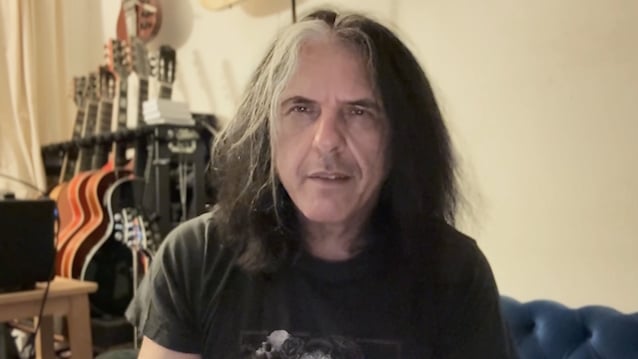
TESTAMENT guitarist Alex Skolnick says AC/DC's Angus Young "deserves a lot more credit" as a musician, pushing back on the idea that Young is valued more for his stage antics than his playing.
Speaking with Rad Jet, Skolnick traced his own guitar influences back to childhood, saying he started playing at age 10 after being drawn in first by John Lennon, Paul Stanley and Elvis Presley, and then decisively by Chuck Berry after seeing him in the film "American Hot Wax." He said hearing Van Halen's self-titled debut album around 1982, when he was 13, became a turning point that reshaped his entire approach to the instrument.
Asked about AC/DC, Skolnick said Angus Young's reputation as a performer — known for his schoolboy uniform and high-energy stage presence — has often overshadowed his musicianship. "He's a guy that gets a lot of attention more as a performer," Skolnick said. "But he's a really fantastic musician." Skolnick credited both Angus and his late brother, rhythm guitarist Malcolm Young, as significant influences on his own playing, noting that Eddie Van Halen himself was known to admire Malcolm Young's rhythm work specifically.
Skolnick joined TESTAMENT at age 16 in 1985 and remained with the Bay Area thrash band for eight years before departing in 1993 to study jazz at the New School for Jazz and Contemporary Music in New York. That period shaped a genre-crossing career that runs alongside his continued work in TESTAMENT, including his instrumental jazz-rock project the ALEX SKOLNICK TRIO, whose most recent album, "Prove You're Not A Robot," was released via Flatiron Recordings.
Skolnick's comments add to a long-running conversation among musicians about Young's standing as a guitarist, one frequently framed against AC/DC's blues-driven riffing style rather than technical flash — a contrast Skolnick's own praise implicitly underscores.