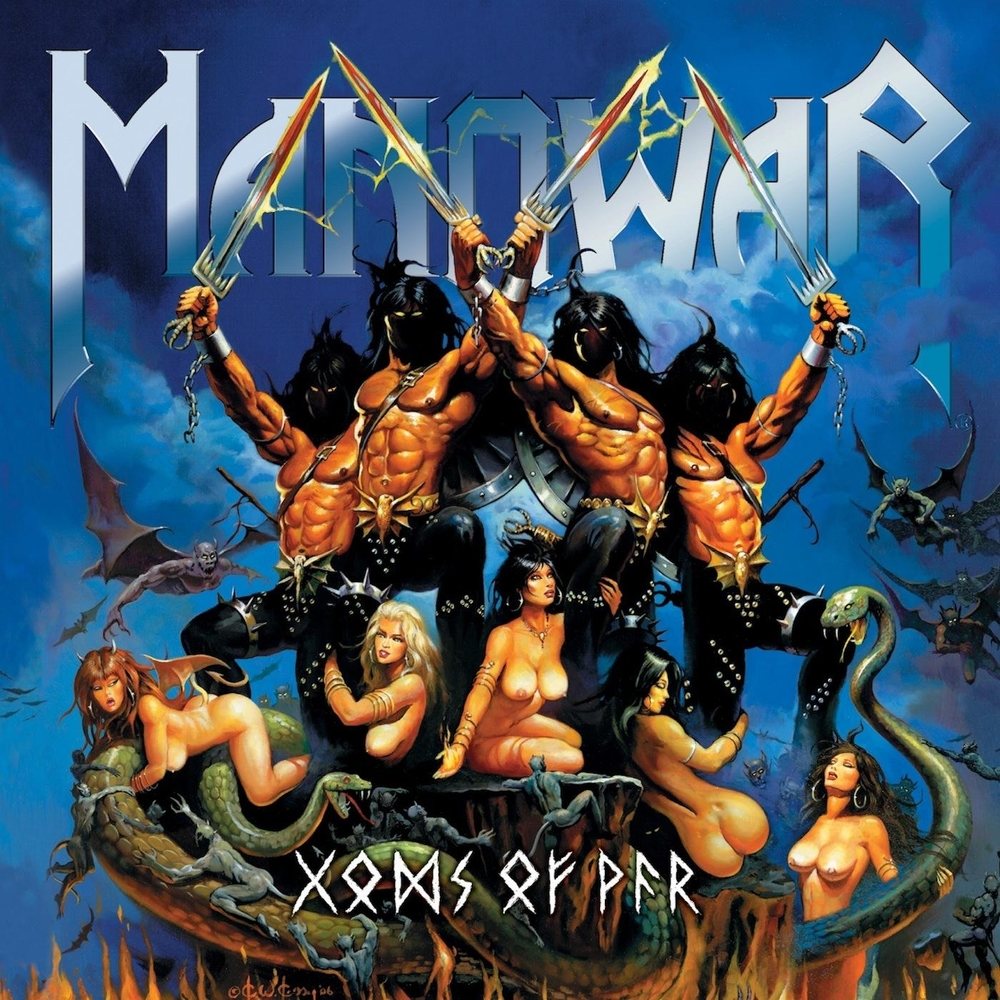
From 1982 to 1988, MANOWAR recorded 6 albums. In 1988 Ross The Boss left the band, and in the nearly 20 years since, the group has recorded just 4 albums. At first the gaps were 4 years, then they went a full 6 years without an album. The current interval is slightly shorter — four and a half years. One thing can be said: these intervals are more than enough to generate absolutely phenomenal hype around the band's new releases. MANOWAR remains one of the most famous and successful heavy metal acts. In recent years, the group has leaned very heavily into epicness (though many thought they couldn't go any further), and performances with an orchestra have become frequent. Information about the new album proclaimed the following: it would be the first in a cycle of conceptual albums dedicated to the Gods of War. And indeed, the first album came out devoted to Odin. A somewhat odd choice, since Odin is the ruler of the gods in Norse mythology, while the god of war is his son Thor — though among certain Scandinavian peoples, Odin was also venerated as a god of war.
Well then, before us lies the album "Gods of War." The disc opens with a 6-minute overture performed by an orchestra. If anyone expects an immediate transition to a speedy battle anthem after that, they'd be wrong. The overture gives way to yet another instrumental, whose opening strongly recalls the "Agnus Dei" from Mozart's Requiem. In the middle of this track, we get a recitative. But then comes an actual battle anthem, "Kings Of The Kings" — a simply excellent song with a characteristic slow section in the middle, built entirely on vocals. "Army Of The Dead Part 1" is an ANTI-instrumental, since the song is a choral chant without guitars, orchestra, or anything else. Next, another battle track with a monotonous intro is dedicated to the enormous beast — the wolf Sleipnir, one of the chief enemies of the Aesir. Having mentioned Sleipnir, it would be unfair not to mention his father — the fire god Loki — hence, the next composition is about him, the chief hypocrite of Asgard. The song features a simply excellent guitar solo. "Blood Brothers" is one of the most beautiful ballads on the disc; Eric is still in outstanding form, which can only bring joy, and his emotionality and sensitivity haven't gone anywhere. The next two tracks are dedicated to Odin — first an instrumental, then a recitative over the sounds of thunder, all transitioning into "Sons Of Odin," one of the main songs on the disc yet at the same time completely unsuccessful, built on very simple riffs and ending with an already unoriginal choral chant. Then another recitative. Followed by the title epic "Gods of War," incredibly pompous. "Army Of The Dead Part 2" differs from the first part only by the presence of organ. Two more epics and the album is done! Although there's also a bonus track that sticks out sharply from everything else — "Die For Metal" — a slow yet very energetic piece that takes us back to the band's work in the 80s.
In summary, we have: 2 instrumental tracks, 3 recitatives where text is spoken over melody or thunder sounds, 2 choral chants, 3 battle anthems, 1 lyrical ballad, 4 epics, and a bonus track.
This disc should by no means be perceived as a standard heavy metal effort. If you're expecting heavy metal, don't even come near this release. The genre of this disc is Epic Rock, plain and simple. Beyond that, opinions diverge. Many fans of the band that once played hard-hitting, dynamic, energetic, and aggressive heavy metal will be clearly disappointed. On the other hand, if you take this disc on its own terms, it is nearly unique. In essence, it is a cantata, possibly even an oratorio. And if anyone thought the band had long ago reached the apex of bombast — that person was catastrophically mistaken.