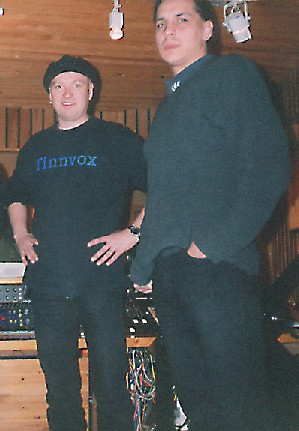
Ind: It's really nice to meet you. Thanks a lot for your willingness to answer our questions. Tell us a bit about your background in sound. We know that you've been doing mastering since 1983. That's a pretty long time!
Mika: Actually, autumn '84. Yes, it's a long time — almost 20 years. I was quite a young kid asking for a job at every music studio in Helsinki just because I was interested and keen on studio work. Finnvox gave me an opportunity to try and put me in the mastering suite to cut vinyl and do disc mastering. Remember, this was before the CD came along. And I'm still traveling that same road...
Ind: How did it happen that you got focused on mastering, not mixing, etc.?
Mika: Quite soon I realized that mastering is just for me, not mixing or recording. Working normally one day per project was enough for my nerves... hah hah.
Ind: Some people don't think that mastering is so important. They don't even know what mastering is or what it's for. Could you tell us in two words — what is mastering? Some people say that mastering is a separate religion!
Mika: Yes, you can easily say that. Being a good recording or mixing engineer doesn't mean you understand mastering at all. In mastering, I'm working while thinking about the whole album at all times, not just one song. It's sometimes difficult to make an album mastering as good as a thrilling book, for example — one that sweeps the listener/reader along. The whole album must be listenable from start to finish without any disturbance. And how to achieve that? With equalizing, compressing, editing, listening, trusting your ears, etc. Mastering is the last day in the studio. It's just as important a day as the day in the mixing studio.
Ind: How much time does it normally take to master a full-length album?
Mika: It takes about 5 to 7 hours. It depends on the total number of tracks and the total length of the album. If there are edits to make in songs, it also takes longer. Sometimes I do basic mastering on the first day, burn a CDR reference for the producer and band, and then on another day I make corrections and necessary changes before the final master. That is absolutely the best way to work in mastering.
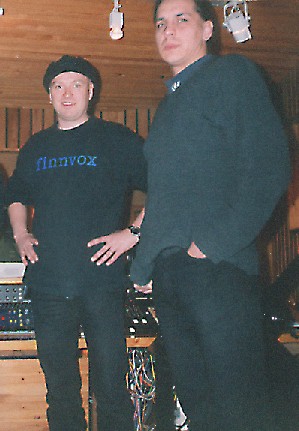 Ind: You are famous for your outstanding work with many prominent metal bands. Do you like metal music? How much? Do you approach mastering metal differently from mastering other stuff?
Mika: I like all kinds of music that are good enough in their own category. I will master all kinds of music. Of course, I mostly do metal, hard rock, and guitar-based rock because I'm quite good with that... hah hah... And you know, the more I master metal, the more bands want me to do the mastering, and the more metal you get to master. That's fine with me, and I don't complain about the situation, but I do master a lot of other stuff too.
Ind: We also know that you've worked with just a few bands from russia. Do you work equally with every band, no matter if it comes from Finland or Thailand, if it's signed to a big label or unsigned?
Mika: Absolutely yes! Every band is treated equally when working with me. The only thing that might make me look for shortcuts is a low budget from a small band or label, but I really hate doing something with half the lights on. I always prefer the best quality mastering, and it will cost what it costs. But if you can't afford Finnvox, don't hesitate to turn to us anyway. Working with newcomers and inexperienced bands is just fun for me, because I can give them so much advice and share my experience with them.
Ind: The Finnish metal scene has experienced a fantastic breakthrough recently! We assume Finnvox has played an important role in raising the Finnish metal scene!
Mika: Yes, of course. But we have to give recognition to those engineers working in our studio — Mikko Karmila, Hiili Hiilesmaa, Timo Tolkki, T.T. Oksala, for example.
Ind: You encounter a lot of music every day. Have you gotten used to music in general, or does it nevertheless remain one of your core life interests?
Mika: Music is part of my everyday routine. I'm mastering all the time — all the sounds I hear: traffic, nature, radio, movies... you know, like "too much low end," "a nasty peak at 2.3 kHz," and so on. Nowadays, I listen to music almost only in the studio. I let my ears rest at home. My hearing gets a workout of about 8 hours every day, and after that it's quite nice to have silence around you... if it's even possible with a noisy and loud family... hah hah.
Ind: Do you have favorite bands and musicians? And yes, sound producers of course?
Mika: There come times now and then when I grab my favorite records from the shelf. AC/DC, Neil Young, ZZ TOP, THE WHO, THE ROLLING STONES, THE BEATLES, DEEP PURPLE, LED ZEPPELIN... etc. And as you can notice, all those favorites are from the 60's, 70's, and maybe 80's. About engineers and producers — anything goes. I'm really honored to have the opportunity to work with those engineers I mentioned above.
Ind: Mastering sometimes works wonders. To what extent, then? Are there cases when mastering doesn't help?
Mika: I don't think so. We can always improve something.
Ind: Do you think that mastering leaves room for artistic and sound production as well?
Mika: Yes, for sure.
Ind: How often do you encounter mixes that you don't like from a mixing standpoint?
Mika: Not so often, and I'm glad about that.
Ind: I assume you're also responsible for editing. What else do you do?
Mika: Yep. Editing is just part of mastering. But at Finnvox... hmm... I also try to do some sales promotion and consulting.
Ind: You're not the only one responsible for mastering at Finnvox Studios.
Mika: No, I'm not. There are three really different-sounding mastering engineers working full time here. I came in '84, Pauli in '89, and Minerva (she) in '95.
Ind: Tell us a few words about the area. It looks like industrial suburbs! Would you prefer a peaceful landscape?
Mika: Yes, I would. The area where Finnvox is located is a big industrial zone in Helsinki. Of course, it would be nice to work in the countryside, for example, but today Finnvox is an enormous complex of music studios that can't be moved anywhere.
Ind: Finnvox is getting more and more popular worldwide. Are you proud of yourselves? Can you say that Finnvox is a friendly team or family?
Mika: Finnvox is absolutely all of that — a team, a family, a hobby, a job, whatever you want to call it. As for popularity, we can still improve a lot in that area. We're not that famous worldwide yet.
Ind: Do you have any comments about world mastering standards? What is the exact difference between world-class mastering and amateur mastering?
Mika: Experience, human skills, equipment, and studio environment. And we're proud to be in the world class.
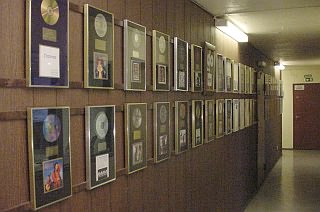
Ind: Can you remember any funny incidents connected with your work?
Mika: Lots of them, for sure, but they're mostly funny only to me.
Ind: Have you ever been to ex-USSR states? Metal activity is far from brilliant in our part of the world. Most bands are unsigned and can't afford a decent recording. Of course, it's also because of the economic situation. But do you think there's any ray of hope?
Mika: I haven't been to russia. But when it comes to the russian metal scene, there is always hope — you just have to work hard.
Ind: How much do you work? And how do you like to spend your free time?
Mika: I normally do 8 hours a day. But in rush times, even 10 to 12 hours. I don't work on weekends or holidays. In one year, I master over 200 albums and several dozens of singles and separate tracks. In my free time, I can really take it easy, do nothing. I just have fun with my family.
Ind: Thanks a lot for this interview. We really admire your work, and I'm sure you know yourself that your name has become a trademark of excellent sound!!!
Mika: Thank you for your kind words. You can always contact me and Finnvox if you have something in mind... And remember to visit our website www.finnvox.fi.