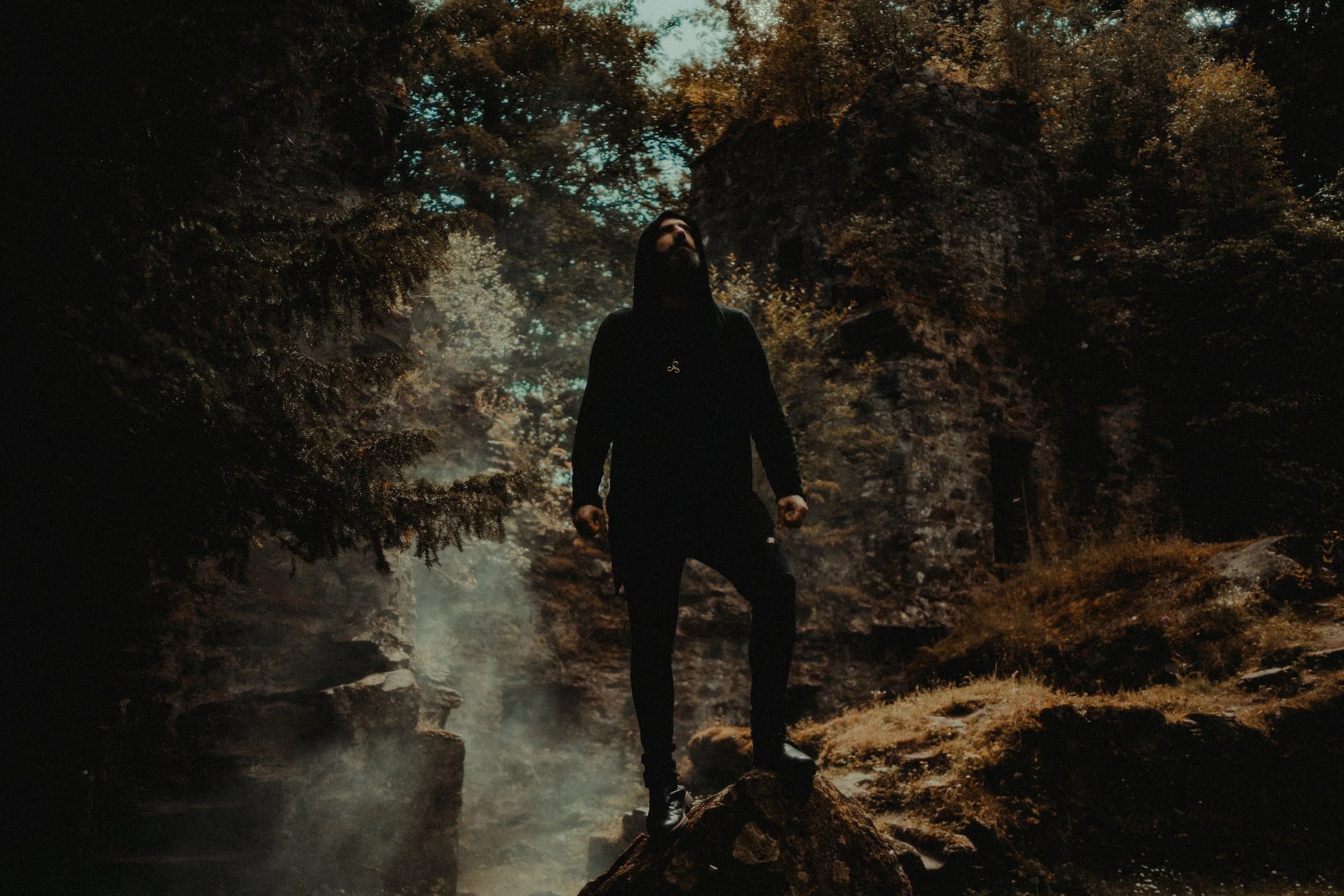
Scorpio: Before we get into the music — I came prepared today. I'm wearing a DRUDKH shirt right now. I'm from Ukraine, and I know you're a big fan. You were even at one point involved with OLD SILVER KEY — the project of Roman from DRUDKH and Neige from ALCEST. How did that come about?
Andy Marshall: I never actually got involved with the project in the end. I quite liked the OLD SILVER KEY release, and I reached out to Roman and asked if I could be involved. He didn't really want to continue with it at that point, so he said, "You can take the reins." I was like, "Okay, that's strange, but okay." [laughs] I was meant to do vocals, but nothing ever happened. I never even spoke to Neige about it — it was just an idea, really. Roman heard some demos I'd written that were similar to that style and said, "Do you want to just use those songs as OLD SILVER KEY?" I was shocked by that, honestly. But nothing came of it in the end.
S: Neige did appear on Forgotten Paths as a guest vocalist. How did that collaboration come together?
A: It was great. I've known him for many years — we're not close friends or anything, but we've met a couple of times at festivals and when ALCEST played in Glasgow. I've always been a fan. The first release, Le Secret, I absolutely love that one. It was my first introduction to post-black metal — or post-rock, shoegaze with black metal, whatever you want to call it. Blackgaze? I'm not sure what the correct term is. [laughs] It holds a real nostalgic place for me. I love his screams, I love his vocals. So it seemed natural to reach out and ask if he'd be up for a guest appearance, and he was happy to do it.
S: Let's talk about SAOR. Am I pronouncing it correctly?
A: It's SAOR [Seur].
S: What does it mean, and why did you choose it?
A: It means "free" in Gaelic. Honestly, I just liked the look of it — aesthetically, the word looked nice. I could already see the logo idea in my head. I liked the meaning too. That was it. Nothing too deep. [laughs]
S: You call your music Caledonian metal. For someone who has never heard it, how would you describe that?
A: It's really just a genre tag I invented for myself, because I always get classed as black metal — and I don't particularly like that label, because I don't see SAOR as a black metal band. We definitely have black metal influences, atmospheric black metal influences especially. I grew up listening to a lot of black metal. But there are so many other things in SAOR's sound: folk influences, soundtrack-style composition, post-rock. It's a merger of different genres. I also think that a lot of true black metal fans wouldn't necessarily enjoy SAOR because of the major-key sections, and it's certainly not about Satan and all that. [laughs] So I thought it was cool to call it Caledonian metal — which basically just means Scottish metal. Caledonia was the Roman term for Scotland, and I kind of like that.
S: Have you seen other bands adopt that label?
A: No, not really. Then again, I don't keep up with new bands all that closely — I genuinely don't have the time. So maybe there are some out there. Who knows? Get in touch. [laughs]
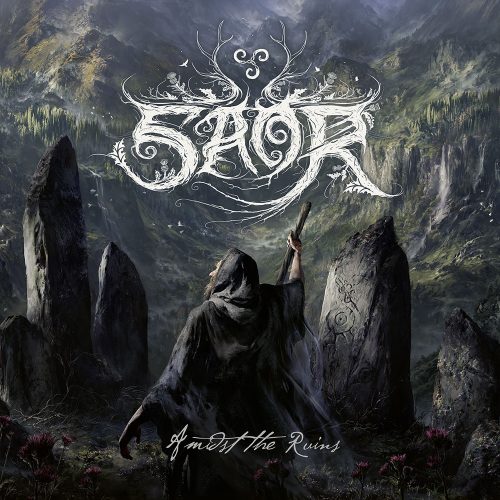 SAOR — Amidst the Ruins (2024)
S: Amidst the Ruins came out just over a year ago. Now that you've had time to reflect, what are your thoughts on it?
A: Honestly, I don't listen to it much, because I play it live so often that I don't really want to revisit it at home. That's just how I work — I get the inspiration, I record it, I release it, and I move on. I don't dwell on older albums. But I'm very proud of it. The guest musicians did a great job: Carlos on drums, Ella on the folk instruments, and Jo did the string parts beautifully. I'm really happy with everyone I worked with. For me personally, it feels like a step above the previous release.
S: One of the songs, "Glen of Sorrow," deals with the Massacre of Glencoe. As a Scotsman, how personal is that history to you?
A: Not particularly personal, to be honest — it's just genuinely fascinating history. Most of the songs I write about historical events aren't personal in that way. It's more an interest in the history and heritage of my country. The problem is we were never really taught much of this at school — it was always World War II and the usual curriculum. Scottish history was barely covered, at least when I was at school, which was a long time ago now. [laughs] So I take inspiration from things I've read and explored on my own, combined with the landscapes and natural environment of Scotland.
S: Staying on historical battles: the Battle of Stirling Bridge. I've heard you mention in a previous interview that Braveheart famously omits the bridge entirely.
A: [laughs] Yes — and the bridge is literally the key point of the Battle of Stirling Bridge. It's a good film, but it's basically fantasy. Loosely based on history, not very accurate. Good entertainment, though. My approach to writing about history is usually more impressionistic — for example, Origins, the previous album, was loosely based on the Pictish people, but I wasn't directly writing about specific events. It was more about absorbing the atmosphere of that era and the landscape surrounding it.
S: I visited Stirling last year and stood on the modern stone bridge there. The actual battle was fought on a wooden bridge — that's why it collapsed under the weight of the knights' armour.
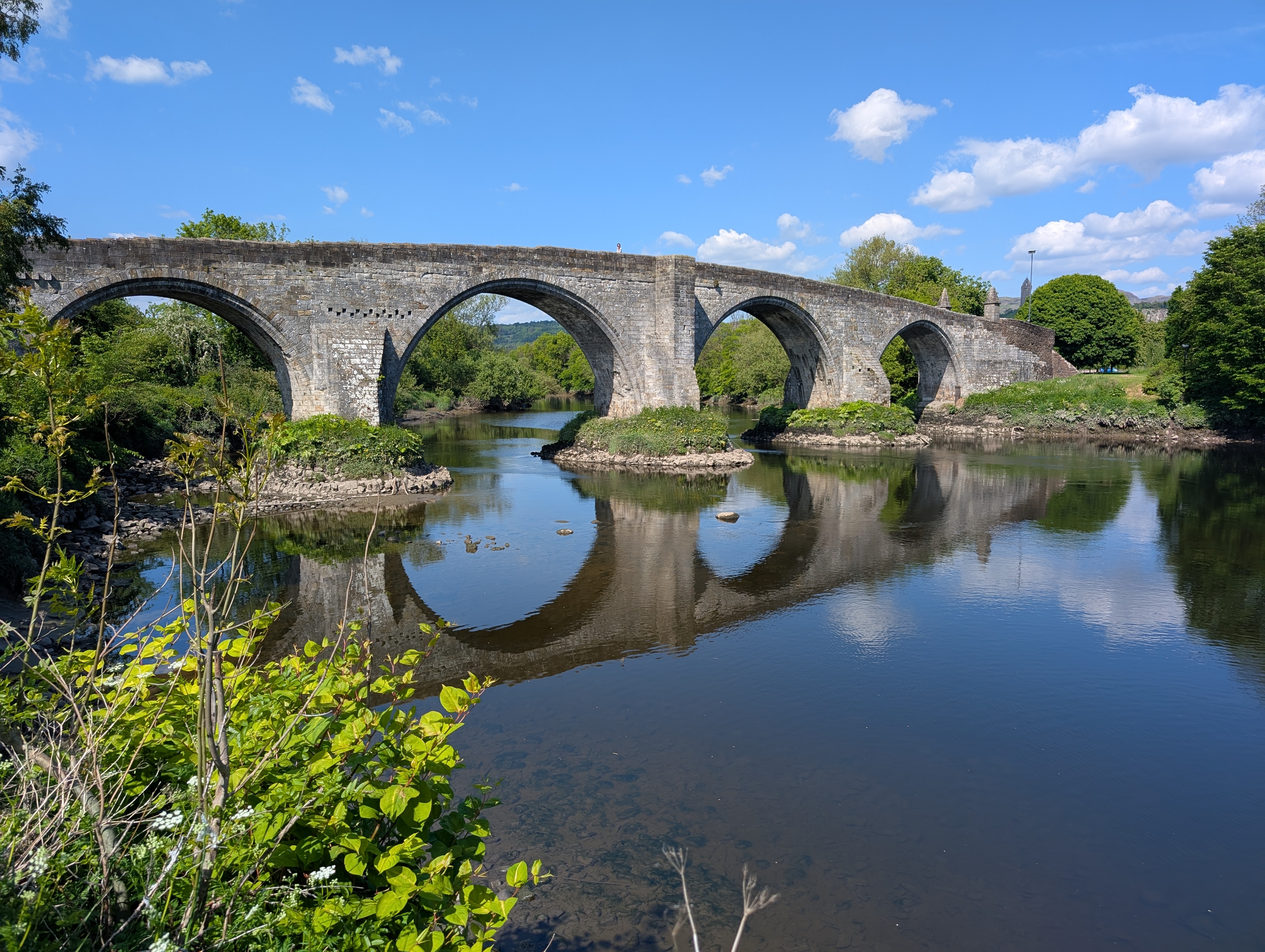 Stirling Bridge. Photo: Volodymyr Osypov
A: It was marshy around the riverbanks too, I believe. A lot of soldiers piling on top of each other in heavy armour isn't ideal, to put it mildly. [laughs] It's a fascinating piece of history, but it's only one small fragment of Scotland's story. Because of Braveheart, it's become the defining image — guys in kilts with face paint charging at each other. That's not really the history. If you want something more accurate, Outlaw King came out a few years ago — it covers Robert the Bruce and it's far more grounded historically. Worth watching.
S: "Sylvan Embrace" is a purely folk instrumental — quite a departure within a metal album. How did the collaboration with cellist Jo Quail come about?
A: I messaged her and asked if she'd play on it. I'd seen her at Inferno Festival in Norway, where she played cello with a loop pedal setup, and the whole room was mesmerised — metalheads included. It was surprisingly heavy, actually. I knew she'd also worked with WINTERFYLLETH, friends of mine. So I just emailed her, she said yes, I sent her the acoustic track and told her to do her thing. She added so much atmosphere. I'm really happy with how it turned out. If I'm being honest, looking back, I might shorten it slightly — it's a fairly long piece — but that's only a fleeting thought.
S: You compose almost everything yourself. Where does that leave the guest musicians in terms of creative input?
A: On Amidst the Ruins, Ella composed some of the flute parts herself, while I wrote others, and in some cases she adapted my initial ideas. For drums, I create a basic MIDI map and send it to Carlos or whoever the session drummer is, with the instruction to play it more naturally — add fills where appropriate, but keep the core idea intact. The guitars, bass, structures, vocals — all of that is me. I'm happy for the musicians to improvise where it improves things, but the final call is always mine.
S: Some bands create convincing-sounding folk instruments entirely through software. Why did you choose to work with real instruments?
A: From Roots onwards I recorded tin whistles myself, largely because I wanted to learn to play one. On Roots, I'd barely even picked one up before recording — literally a few days of messing around, and I decided it sounded good. I'm not a professional player by any means. I do use synth pads and ambient textures through keyboard instruments, but for the folk elements I've almost always used real instruments. They feel more authentic — even if the tuning isn't perfect in places, there's a quality to it that synthesised versions can't quite replicate. Keyboards can sound a bit robotic in that context. Though plenty of bands pull it off very well — it really depends on what you're going for.
S: Live, you have Ella playing bagpipes and whistles on stage. But strings are harder to tour with.
A: Exactly. You can't bring a cellist and two violinists on the road. Having Ella cover the pipes and whistles gives the live show a real sense of authenticity. People want to see it being played in front of them. As for the full string section — that's not happening. [laughs]
S: Has travelling with instruments caused problems?
A: We've been fairly lucky, actually. We use ENKI cases, which are very sturdy, and I haven't had major issues. But we've had guitars broken in half in the past. Baggage handlers genuinely do not care what's in the case — you can cover it in "Fragile" tape and it makes no difference whatsoever.
S: Let's talk about your other project, FUATH. How do you pronounce it?
A: FUATH [Fuah].
S: How did it start, and why did you need a separate outlet?
A: FUATH has no folk elements — the themes are darker, the music is more dissonant, faster, rawer. It's more influenced by the early black metal I grew up with, the kind of material that doesn't fit within what SAOR is doing right now. It's an outlet for the darker side, if you want to put it that way.
S: Do you play live with FUATH as well?
A: We do — three shows this year. One at Fell Foot Woods in Cumbria, which is a forest setting that really suits the music. One in Glasgow. And then Bristol Extreme Fest, where ROTTING CHRIST are headlining. We don't play anywhere near as many shows as SAOR, partly by design — I like keeping FUATH rare — and partly because getting everyone together is logistically difficult. We all have families, jobs, busy lives. Last year with SAOR we played too many shows, so this year is intentionally quieter on the live front.
S: SAOR, FUATH — you use Gaelic for your band and song names. Have you ever considered using it in the actual lyrics as well?
A: No, I don't. I came across these words and liked how they looked and what they meant. There's a substantial Gaelic-speaking community in Glasgow, and the language is going through something of a resurgence at the moment — it was never taught at school when I was growing up, and resources for learning it were limited for a long time. I just saw these words as a young person and thought they sounded right for what I was doing. I don't think there'll be any Gaelic in the actual lyrics unless I find someone who can genuinely speak it and contribute something on a future album.
S: Would you consider it?
A: Maybe, in the future. But I wouldn't want to force it. It would feel a bit like me recording an album in Ukrainian — I don't speak the language, so I'd feel absurd even attempting it. I'd need to be at least partly fluent to feel I was doing it justice.
S: I think Ukrainians would actually be very welcoming of that — even someone just trying, making the effort to learn a few words or phrases.
A: Next album — all in Ukrainian. [laughs]
S: When I was in Scotland last year, the parallels with Ukraine struck me quite strongly. You have your own history with an imperial neighbour. russia spent centuries trying to erase Ukrainian culture and language — and I think one of the reasons Gaelic isn't spoken as widely as it once was is English imperialism. Your band is called "Free." What is your stance on Scottish independence?
A: I'm on the fence at the moment. At the first referendum, I voted Yes — I voted to leave the UK. But since then, the political landscape in Scotland has changed considerably, and I'm not particularly enthusiastic about the parties currently pushing for independence. If we had another referendum, I'd want to do a lot more research — look at the actual pros and cons, understand what independence would mean in practice. The first time I voted with my heart rather than my head. I'm older now — wiser, possibly. [laughs]
I'd also push back slightly on the framing of England as some uniquely imperialist force, because Scotland was very much part of the British Empire. We weren't reluctant participants — we were active partners in it. Scotland attempted its own colonial ventures, including in Panama. There are also aspects of Scottish history, like the Highland Clearances, where Scottish landlords played a direct role in displacing their own people. Plenty of Scots saw themselves as British first — and some still do today. It's very complicated.
I wouldn't compare it directly to the situation in Ukraine, to be honest. What's happening there is unambiguous — it's very clear who the aggressor is. The Scotland–England relationship is far more layered than that.
S: Scotland does seem to have been a strong supporter of Ukraine, though. I saw EU flags flying outside the Parliament, even after Brexit.
A: Yes — and that's another part of the complexity. Scotland voted overwhelmingly to remain in the EU. The UK-wide vote went the other way, so we were pulled out against the wishes of the majority here. That still generates a lot of bitterness, and understandably so. As for Ukraine — the support here is real and substantial. Our manager Joe is extremely involved: he attends protests, organises fundraising metal shows, does a lot of important work. We joke that he's basically the Ukrainian equivalent of a Japan obsessive — completely devoted to the cause. [laughs] But that's said with enormous respect.
I wore a Ukraine support T-shirt at Kilkim Žaibu festival in Lithuania — a fundraising initiative that travels the metal festival circuit. Of course I was happy to wear it. I totally support Ukraine. I hope Ukraine wins. And they will win. When it was first reported, I found it genuinely unbelievable — I think most of the world did. Though I suspect Ukrainians were less surprised. It's an absolute disgrace that it's happening.
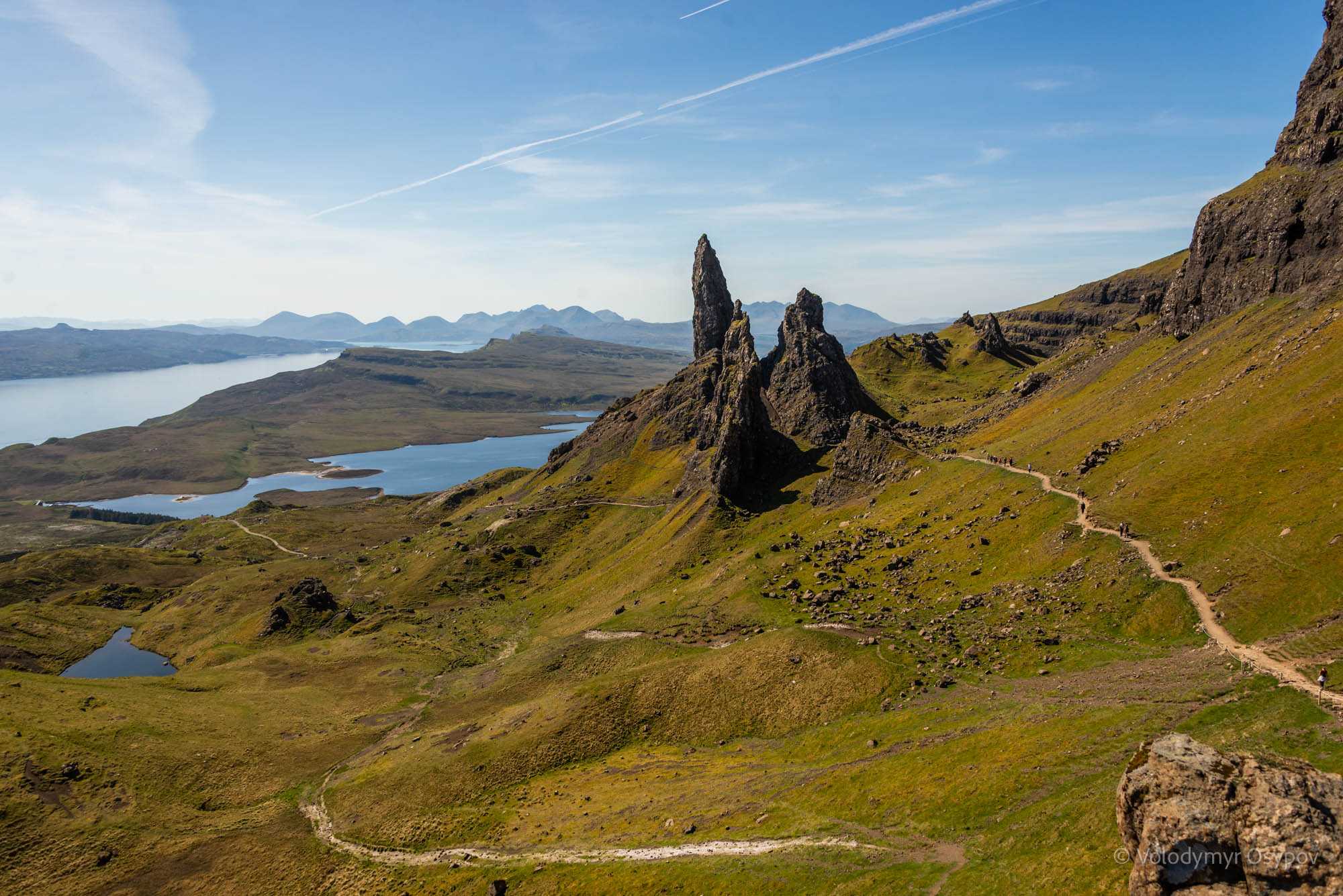 Old Man of Storr, Isle of Skye. Photo: Volodymyr Osypov
S: Your visual world — the videos, the artwork, the vinyl packaging — is saturated with Scottish landscapes. The video for "Amidst the Ruins" features the Old Man of Storr and the Kilt Rock waterfall on the Isle of Skye. How central is the natural environment to what SAOR does?
A: Completely central. I was obsessed with hillwalking and camping from a very young age — being outdoors, playing in forests, all of that. Life has made it harder to get out as much as I used to, but I'm still not far from it. From Glasgow you can be at the start of the Highlands in half an hour, and in Glencoe in about two and a half. We're very lucky in that regard. The only drawback is the midges. [laughs] They absolutely target me specifically — I must have something in my blood they love.
My real awakening to landscape as something significant came when The Lord of the Rings films came out, around 2001 — I was about thirteen or fourteen. I was completely obsessed with those New Zealand landscapes. Then we went on a family holiday up north that same year, it was snowing, and I looked at the mountains and thought: this is on my doorstep. For some reason I'd lived there for thirteen years and never really seen it. My dad is into hillwalking, we went out together a few times, the family camped — and it became a huge part of my life. I really dislike cities. I need to be away from all of that.
S: If you could play anywhere in Scotland, with no logistical or legal constraints, where would it be?
A: Glencoe. Specifically, somewhere near the Three Sisters — those three mountain ridges in the glen. Every time I drove past I used to think it would be a perfect festival site. The mountains, the drama of it. Of course it will never happen — it's a protected area, the local council would have heart attacks, the residents would be furious. But in fantasy? Absolutely Glencoe.
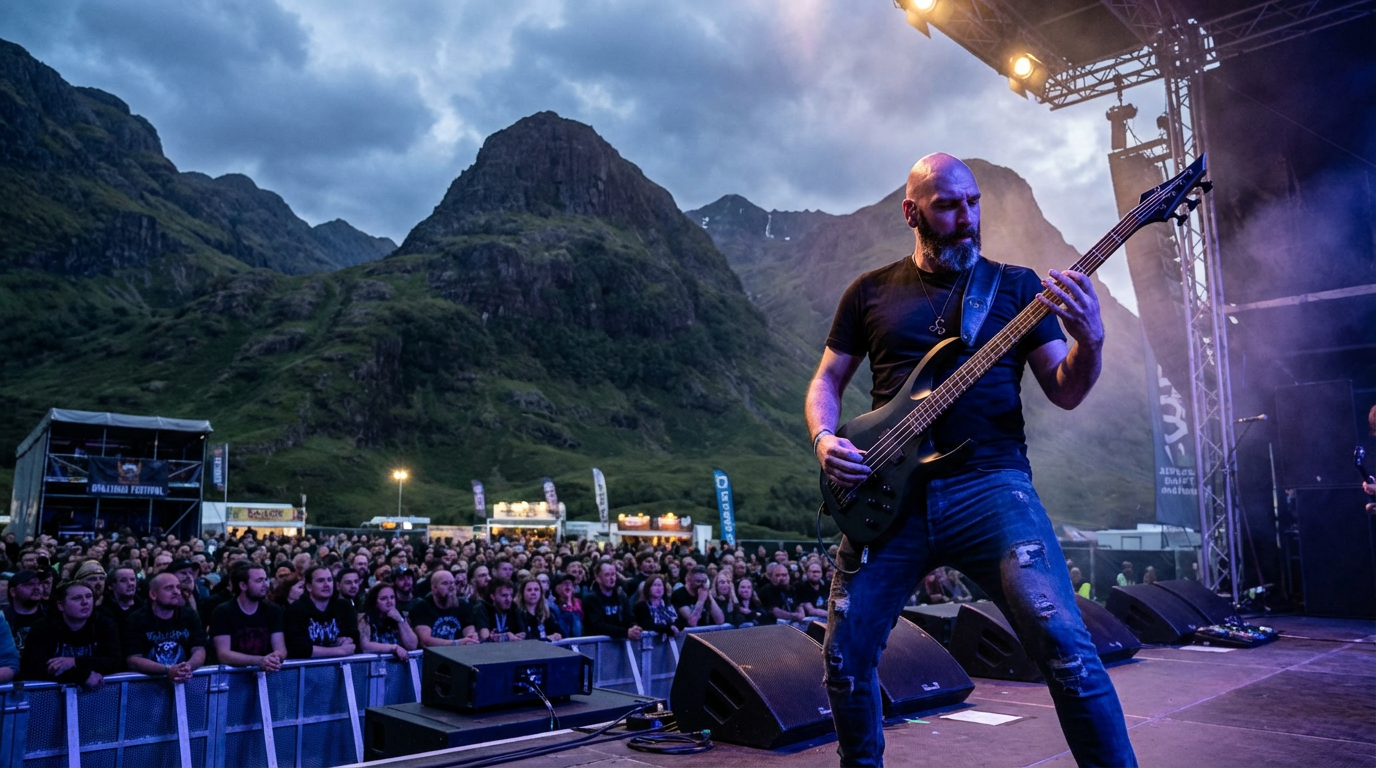 SAOR playing at Glencoe — Andy Marshall's dream concert location (AI generated)
S: Scotland is famously associated with whisky. Are you a whisky drinker?
A: No. [laughs] Not at all. Everyone asks me this. I just never liked it. I'm a beer drinker — always have been.
S: Any Scottish breweries you'd recommend?
A: Definitely not BrewDog — though they've had their troubles, to put it diplomatically. The founder raised money from investors through crowdfunding, became a millionaire, and the investors were left with nothing. Not very punk. [laughs]
For genuine recommendations: Williams Brothers make some excellent stuff — their Caesar Augustus, an IPA-lager hybrid, is really good. I like a beer called Schiehallion, and there's one called Bitter & Twisted that's worth trying. My actual go-to these days is Guinness, which I never used to drink at all — I was always a lager and IPA person. But since a trip to Dublin, I'm completely converted. Murphy's is also excellent.
As for IPAs — I've gone off them. My tastes have just changed. I used to love them, but now all I can taste is perfume. It's a shame. If you just want a reliable pint on a night out, you really can't beat Tennent's Lager. It is what it is, but it does the job.
S: There's even a meme about IPA drinkers — a guy licking sap off a pine tree.
A: That's exactly it. That's all I taste now.
I actually have a home pub setup as well — a PerfectDraft machine. You buy kegs at the shop, each one roughly eight pints, at about £2 a pour. Much cheaper than going out. Excellent investment.
S: I moved to the US when I was 21 and told people there: "In the US you start drinking at 21. In Ukraine, you stop drinking at 21."
A: [laughs] That's very true. I feel that completely when I'm on tour with the band. Our manager Joe and our guitarist Martin are the only other Scots — the rest of the session musicians are from various parts of Europe. The cultural gap is very real. We'll be at the airport at six in the morning thinking about a pint, and the others are genuinely horrified. By the end of the night we're still going, and they're asking how we function. It's just in the DNA, at that point. [laughs]
That said, I drink far less than I used to. I'm much more focused on fitness now — gym, weight training, clean eating. Beer is an occasional treat. When you get older the hangovers become genuinely not worth it. My limit is probably five pints, and that's pushing it.
S: Finally — what's next for SAOR?
A: I've already recorded something that I'm hoping to release later this year. I can't say too much about it, but it's going to be good. I've also started work on something else — so there are two new things on the way. After that, honestly, I want to take a long break. I've released a lot in the last couple of years, and it's always been in the back of my mind to step away for a while — spend more time with family, live a bit, let the well refill. Maybe I'll come back and do something completely different. We'll see.
In the meantime, SAOR has festival appearances confirmed: Brutal Assault, Summer Breeze, and more. Keep an eye out.
Video version of the interview: