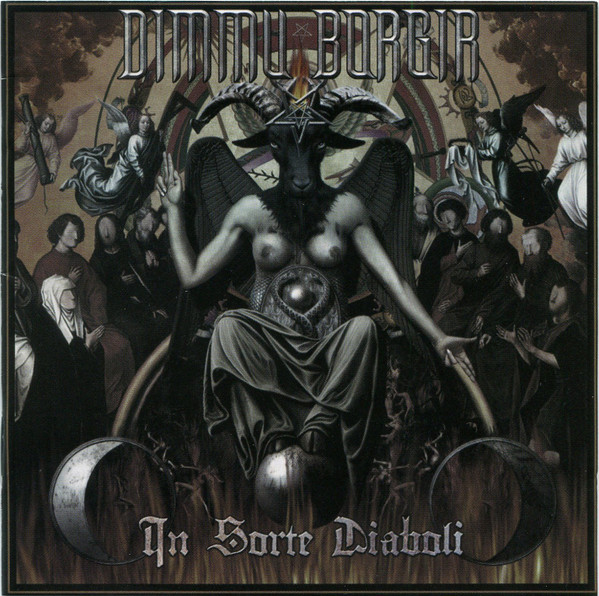
Regardless of one's attitude toward DIMMU BORGIR's music, let's be objective — today they are a commercial band, and the promotional activity surrounding their work confirms this. The new album was presented as something unique in terms of ideological content, with the band positioned as an exposer of Christianity before all of humanity. Shortly before the disc's release, news appeared online: "Before it has even been released, the new album by Norwegian symphonic black metal kings DIMMU BORGIR is being subjected to all manner of persecution. This time the original cover art has suffered." In the original version, Baphomet sits on a throne with angels flying around him and blind worshippers standing below; in the second version, only Baphomet is depicted without the surrounding figures. Whether this actually materialized is an open question — in Europe, the album was released in its original form, but they certainly generated plenty of buzz. The musicians' portraits in the 32-page booklet, designed by Joachim Luetke, are executed in the traditions of the High Renaissance; the song lyrics are stylized as a Kabbalist's manuscript and are preceded by a multi-page story about a medieval sorcerer, somewhat reminiscent of an inverted "Life of Francis of Assisi" — where the saint had God revealed to him after asceticism, Silenoz's hero discovers the Devil. At the same time, the album's lyrics present nothing unique: the protagonist reflects on how he opposes everything, especially the church, and is ultimately burned at the stake. Moreover, the album's hero is more of a devil-worshipper than an atheist — what is the point of substituting one religion for another is a question for Silenoz. In short, yet another not entirely successful attempt to philosophize about the terrible harm of Christianity by a person living in one of the wealthiest capitalist countries and enjoying all the benefits of European civilization, which, like it or not, is 100% Christian.
Now about the music. What can be said here — lessons have been learned. Unlike "Death Cult Armageddon," the recording of "In Sorte Diaboli" didn't follow the logic of "let's cram the album with everything our budget allows." Everyone remembers the tons of bombast and the feeling of being overproduced, which seriously undermined the disc's substance. Two years ago, the leaders of the Norwegian scene re-recorded their second album "Stormblast"; veterans Shagrath and Silenoz performed the bass parts themselves, giving Vortex a break, while the famous Hellhammer was already on drums. He mans the drum kit on this release as well; Vortex has rightfully taken the bassist position, and as on previous releases, he performs virtually all clean vocal parts. Guitarist Galder hasn't gone anywhere either. There is no orchestra this time, so all the burdens of symphonic sound fell on Mustis and his skills in computer-based music production. The result, let's say right away, is more than worthy. The album even features a magnificent and very beautiful keyboard piece, "The Fallen Arises." In terms of musical content, there are of course many motifs similar to Armageddon, but there are also more interesting retrospective callbacks — "The Conspiracy Unfolds" takes us back to the times of Misanthropy-era, a brilliant track and possibly the strongest on the album. Another composition, "The Sacrilegious Scorn," is crafted in the spirit of songs from the 1999 album "Spiritual Black Dimensions." Discussing the quality of recording and mastering is, I think, unnecessary — everything is top-notch, naturally. Shagrath's vocals once again sound different — very dark and menacing; the low growling parts have virtually disappeared. Overall, the compositions are best perceived as a cohesive whole, in sequence with one another. The band managed to make the disc conceptual not only in terms of lyrics but musically as well, which is achieved quite rarely. Because of this, on the other hand, after a first listen the album may seem bland — it isn't; you simply need to let it grow on you.
Also, the licensed edition includes the DIMMU BORGIR Media Player and the music video for the album's opening track, "The Serpentine Offering." It's of very high quality, though not full-screen. Visually, the video is simply outstanding. Set to the music, it depicts the forced conversion to Christianity in a European village, carried out by crusader knights alongside monks, all dressed in late-medieval attire. In the end, one monk renounces Christ, becomes a devil-worshipper, and his eyes resemble those of Sapkowski's Witcher. From a historical standpoint, the video is completely absurd and riddled with anachronisms, yet it is made very professionally and with high production values — in short, Hollywood's golden formula applies, where spectacle takes precedence over substantive value.
The conclusion is fairly straightforward: a very worthy release, definitely recommended for adding to your CD collection.