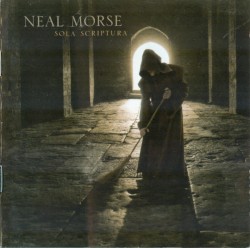
Progressive rock genius NEAL MORSE presents yet another masterpiece. On drums is his long-time colleague Mike Portnoy, Randy George handles bass duties, and Paul Gilbert appears on the first two compositions as guitarist. Keyboards, vocals, and the main guitar parts are all performed by 46-year-old multi-instrumentalist NEAL MORSE himself. The disc contains just 4 tracks spanning nearly 76 minutes. As is customary for progressive rock, the lengthy tracks are divided into sections with no pauses between them.
This is a case where the conceptual side of the album demands discussion. Sola Scriptura is one of the central tenets of the 16th-century Reformation and specifically served as the foundation for Lutheranism. Translated from Latin, it means "by scripture alone." As is well known, Catholic theology by that time consisted of mountains of philosophical and dialectical writings dedicated to rationalizing conceptions of God, unifying the principles of ancient Greek scholars and notions of the Universe, and reconciling them with the Christian religion. The initiator of the Reformation movement, Martin Luther, put forward the famous principle of "Sola Scriptura," which left the faithful Christian with only one source of knowledge — the Holy Scriptures, rejecting virtually all existing theological works and calling for a literal understanding of the Bible. This shattered the authority of the Catholic Church and traditions that had existed for a millennium and a half. The album is devoted to the life and work of Luther. Christian traditions in progressive rock go back quite far; Christian Progressive Rock has long been distinguished as a separate genre, since it carries its own particularities not only in concept and lyrics but musically as well: humanism, a special optimistic atmosphere, choral passages; at times the music recalls new age — all set against the backdrop of virtuosic guitar-and-keyboard whirlwinds.
The 1st track, "The Door," runs just under half an hour. After the supremely virtuosic "Introduction," a drawn-out vocal section, "In The Name Of God," begins; it's interrupted by a powerful instrumental passage, followed by the stunningly beautiful "All I Ask For," an instrumental interlude that even Vangelis would envy, and then the mighty rhythm section delivers fascinating passages joined by solos — as befits progressive music, each part is unique and special in its own way. The next section of the piece strongly recalls the spirit of DREAM THEATER's "Metropolis." Then comes a distinctly Pink Floyd-esque section, "Keep Silent." Another superb passage, and then a thoroughly melancholic ending reminiscent of a soundtrack to some 80s melodrama.
The 25-minute "The Conflict" opens more energetically, with greater attention paid to guitar solos overall. The result is a simply magnificent, colorful canvas of shimmering harmony. In the middle of the composition, a wonderful acoustic solo awaits us. Later the vocals join in, and we hear a gorgeous Latin-tinged song — parts of this section personally reminded me of Sting. Elements of fusion are also present. The last 5 minutes of this track are a kind of idyll and absolute tranquility.
The five-minute ballad "Heaven in My Heart" is pompous on one hand yet strikingly beautiful on the other — it simply astounds with the energy contained within. Initially accompanied only by piano, it soon features programmed orchestral accompaniment with an emphasis on strings.
"The Conclusion" is the closing track of the album. It begins with a blazing-fast keyboard solo, and in genre terms, this is one hundred percent retro-prog! However, it soon gives way to a colossal wall of sound, followed by several alternating vocal episodes, and effectively a reprise of the first track.
Such is this disc. Those seeking depression, chaos, and aggression in music will find absolutely nothing to listen to here. Everyone else, however, regardless of ideological preferences, is strongly advised to have this in their collection. A synthesis of various musical traditions this brilliant and this deftly executed comes along rather rarely.