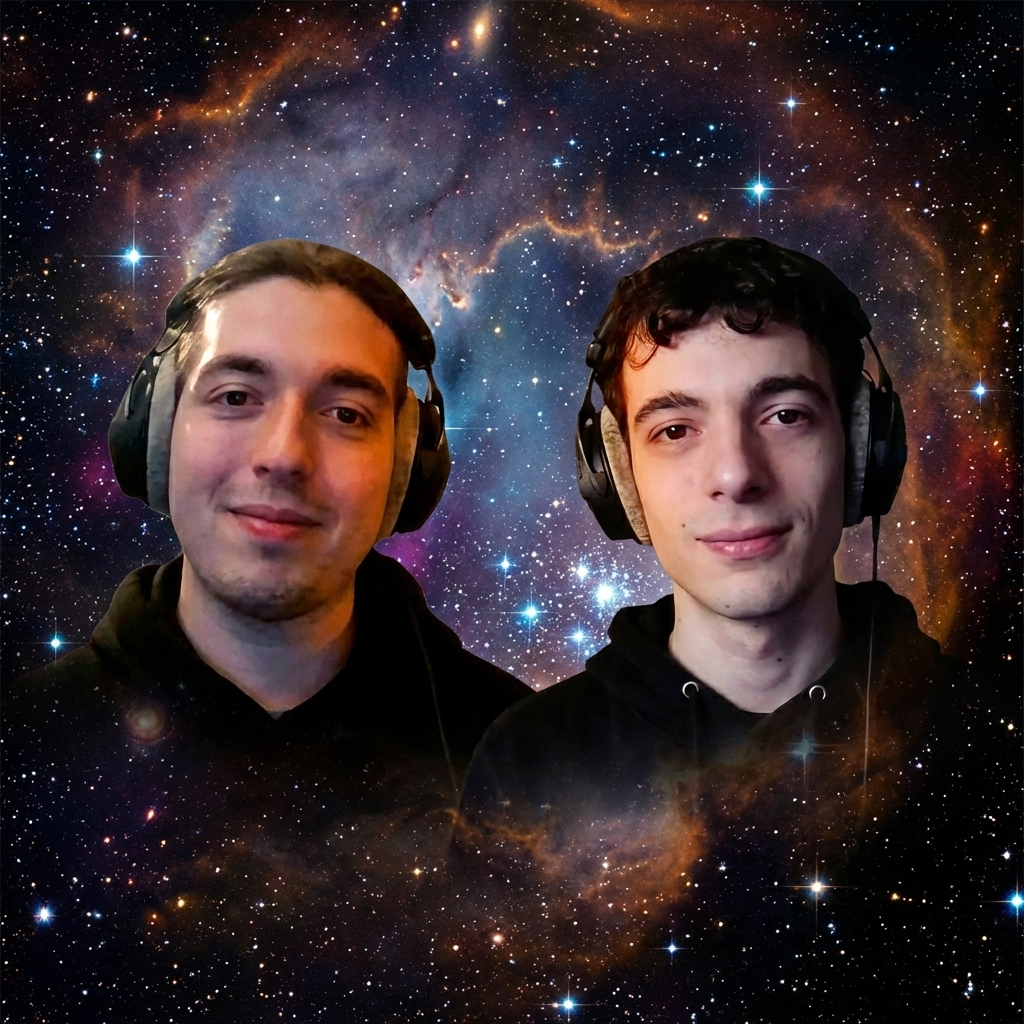
Scorpio: For those seeing you for the first time: what are your names and what do you each do in the band?
Oleksandr: I'm the vocalist — I write the music and handle the arrangements.
Misha: I record guitars and take care of the audio engineering.
S: Over the last three years you've released three albums — an impressive output. You've gone from Odesa to being known worldwide. How do you feel after these three records?
O: Really good — we didn't expect them to land as well as they did, and we're very happy. We're continuing to work on new music. The fourth album will hopefully come out in early 2027, though nothing is set in stone yet.
M: The amount of success we've had is very unexpected, and it gives us a great deal of inspiration.
S: The latest album came out a year ago. How was it received? Do you follow the reviews and feedback?
O: Yes, we follow everything — reviews, feedback, ratings. The album was largely well received. There were, of course, people who felt it wasn't "true" enough black metal, but we never claimed to be that from the start. We were always a more experimental band blending electronic elements, black metal, metalcore, and progressive metal. Most people found that interesting precisely because it was something new. Overall the album was very well received — positive reviews, strong numbers on Spotify and other platforms. Rift in Reality outperformed Vortex of the Worlds and Tales of the Void in terms of streaming figures.
M: A few well-known bands also took notice of the third album. Recently the British band ALESTORM pinned us on their Spotify page — we exchanged a few words and they said "Great music, guys." So it's not just listeners giving us feedback — other metal bands are too.
O: We saw that Christopher Bowes from ALESTORM had pinned us on his page. The first reaction was: "How? Is that even possible? Someone like that knows us and listens to us?" Then we wrote to him, had a chat — and it was really gratifying to know that people like that listen to our music and enjoy it.
S: When can we expect the pirates-in-space collaboration?
O: We'd love that. You're not the first person to ask once they find out about our exchange with Chris. Nothing is planned right now, but it would be amazing. I'd happily do that collab — I love that band and have been listening to them for nine or ten years. An incredible group.
S: Going back to the latest album — it's even more experimental, dancier in places, especially thanks to the first track Voyagers. There's also more clean vocals. What was your creative reference point on this record?
O: Mostly the process is driven by feeling — we do what we feel like, what's inspiring us from other sources at that moment. For example, LORNA SHORE have become a very significant influence for me over the last two years. Misha had been listening to them for a long time, but they never clicked for me — I thought they weren't my thing. Then suddenly it hit me, and I was deeply inspired by their work. So on the fourth album we're even going to include a few deathcore breakdowns. We'll see how it goes.
M: The main idea is to keep moving in the direction of progressiveness. After writing the first album, when you go back to those five tracks, you think: how could we have written such simple music? After working on more complex material, you want to maintain that standard. We wanted to grow as musicians and write something more challenging — for ourselves as well.
S: For those unfamiliar with the concept behind your albums — tell us about the Nirlakh universe. How did it come about?
M: It's a long story, because right now we're actively working on the lore and building out this world. Sash, start from the first album — when did the idea to move from something abstract to something conceptual come to you?
O: Even the first album isn't very conceptual, but it has a general cosmic theme. It was from the second album — when we wrote the track Downfall — that the first proper narrative track appeared, with a real story. From there we began building this story in different directions. It's about the destruction of the planet and the Nirlakhian civilization. We developed it on the third album and will continue on the fourth.
At the center of the story are the Voyagers: not just travelers, but scientists — an expedition departing from Nirlakh to open a portal to the primordial world, the Void. When they arrive, it turns out they encountered something completely different from what they expected. In our lore, the Void is the primordial space from which all life in other worlds emerged. It has its own gods, its own creatures, its own history. But the expedition discovers it has been destroyed — and by opening a rift into the Void, they release a swarm of hostile aliens.
We're not sci-fi writers, of course. There's nothing particularly original about our lore, but we're working on it.
M: When we're writing the lore, we sometimes catch ourselves thinking: "Oh, that's the plot of that game, or that film, or that book." If you know various sci-fi universes well, you can see where we drew certain ideas from — and understand what kind of Frankenstein we've stitched it all together into.
S: Is there any idea to release a book or comic alongside the music, set in your universe?
O: That would be really cool, and we hope it happens someday in the distant future. But for now there isn't enough material, and a project like that — a book or a comic — would require an enormous amount of work from an artist or multiple artists. We're musicians, not artists or writers. To make it happen, we'd need to find people who share the vision and are on the same wavelength. For now it remains a plan for the distant future.
S: Let's talk about the artwork. Sashko, you said you're not an artist, but the first album features your own art.
O: That's right. I drew those three pieces back around 2018, but then I stopped and haven't touched it in a very long time. I've always loved creativity in its various forms — I tried drawing, writing, sculpting figures. When I found music composition, I understood: that's it. Full stop — that's what I want to do above all else. Drawing took a back seat.
By the way, my friend Nastya helped me with the artwork on Tales of the Void — she transformed a black-and-white drawing on paper into that piece with the cosmos, red eyes, and all the details.
S: And what about the second and third albums?
O: The second album came out with AI-generated art. We wouldn't do that now — there's an understanding that it's not the best approach. But at the time AI images had just appeared, and it seemed like something new and interesting. Plus we simply didn't have the resources to commission a professional artist. Quality artwork — like on the third album with Mark Cooper — costs money. And after only one album out, we didn't yet have sufficient merch sales or streams. So we went with the budget option. I don't regret it, but I'd do it differently now.
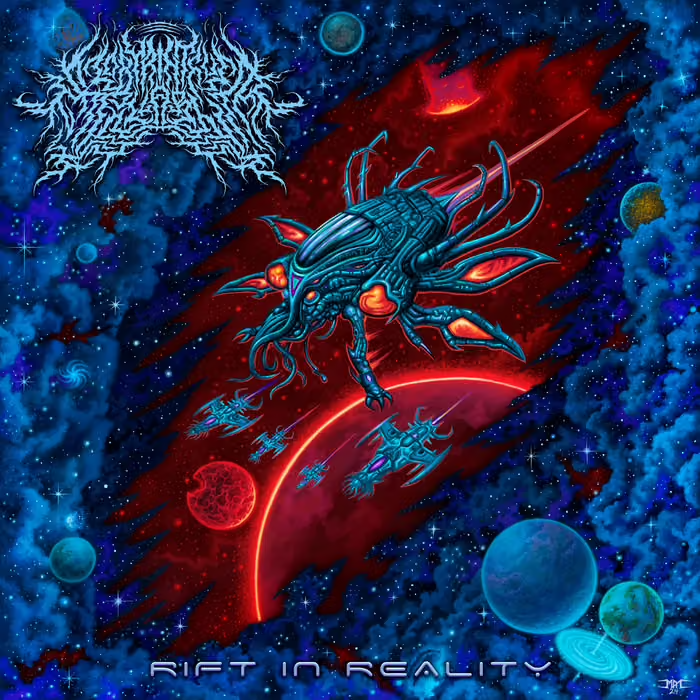
For the third album we commissioned art from Mark Cooper, who has collaborated with RINGS OF SATURN and painted all their covers. An extraordinarily talented artist. He'll be with us on the fourth album too — the commission is already done.
S: How did that collaboration come about? Why Mark specifically? How did you explain your universe to him?
O: Rather than explain the universe to Mark, we quickly sketched out a picture of how we see it: we want a rift between worlds, with sci-fi spacecraft flying out of it — but organic ones. That was our concept, and he realized it beautifully.
M: We'd been listening to and loving RINGS OF SATURN for many years. I can't speak for Sasha, but for me they had some of the best artwork I'd ever seen in metal.
O: And it's not just the covers — RINGS OF SATURN have an enormous range of merch, and all of it is outstanding. I don't know any other band with merch as strong as theirs. All the artwork from the Ultu Ulla era — it's something else.
S: Let's talk about the music itself. LABYRINTHUS STELLARUM is your first musical project. At what age did you start making music, and when did it become clear this could become something serious?
O: I started writing music at 19. Before that I hadn't done it at all — I only listened. I downloaded FL Studio and started trying to write electronic music — this was 2019. LABYRINTHUS came about at the end of 2021, when our guitarist suggested starting a project, something like LUSTRE. I agreed and we started working together. That this could become something serious — I only understood after the first album came out, when I saw that the music genuinely interested people, that they were listening to it, and that we were being offered concerts. That's when it became clear this was bigger than we expected.
M: If that first response hadn't come, if we hadn't seen that people liked it — the second, third, and fourth albums probably wouldn't exist.
I started playing music at 13. As a child, around six or seven, I played classical guitar, but then stopped. Around 2020 I got an electric guitar and started seriously learning to play. Sasha suggested I also learn to write music — and that's how it started.
S: All three albums were recorded in a home studio, and the final quality is very high. What equipment do you use, and what's the secret behind that sound?
O: My setup: a microphone, headphones, monitors, a computer, and an audio interface. Nothing specialized beyond that. Gear-wise, it's all very straightforward.
M: All the magic happens in the computer — in our DAW, in FL Studio.
O: We have programmed drums, programmed bass guitar, synthesizers — all of it made in the computer, so a studio isn't necessary. With live instruments there would obviously be a different dynamic, but that requires significantly more time and budget. We decided that for electronic progressive cosmic music, you don't necessarily need everything to be live. Electronic music doesn't have to be fully "live."
M: It's also worth noting that over the last five to seven years, digital plugins and effects have become so good that recording in a real studio would only give a better result under ideal conditions — say, Abbey Road Studios in London, where an hour of recording costs $15,000. Because all the sound libraries available to musicians today were recorded there. Competing with that at home is a very difficult task.
S: Right now you're both in different countries. How does that complicate working on the music?
O: It complicates things a lot. If we were together, we'd probably have not three albums but five by now. We write music over Discord with screen sharing. When it comes to mixing and mastering — Misha remotely walks me through which knob on which compressor to set how, what the attack should be, what delay to use. That approach significantly slows the process down and makes it less comfortable. But the reality of the current situation is that we unfortunately can't write together in the same room.
M: The last time we saw each other was January 2023. All this time — only online. On top of that, we use different software, so Sasha can't just send me his project files. It's a much bigger hassle than if we were sitting next to each other.
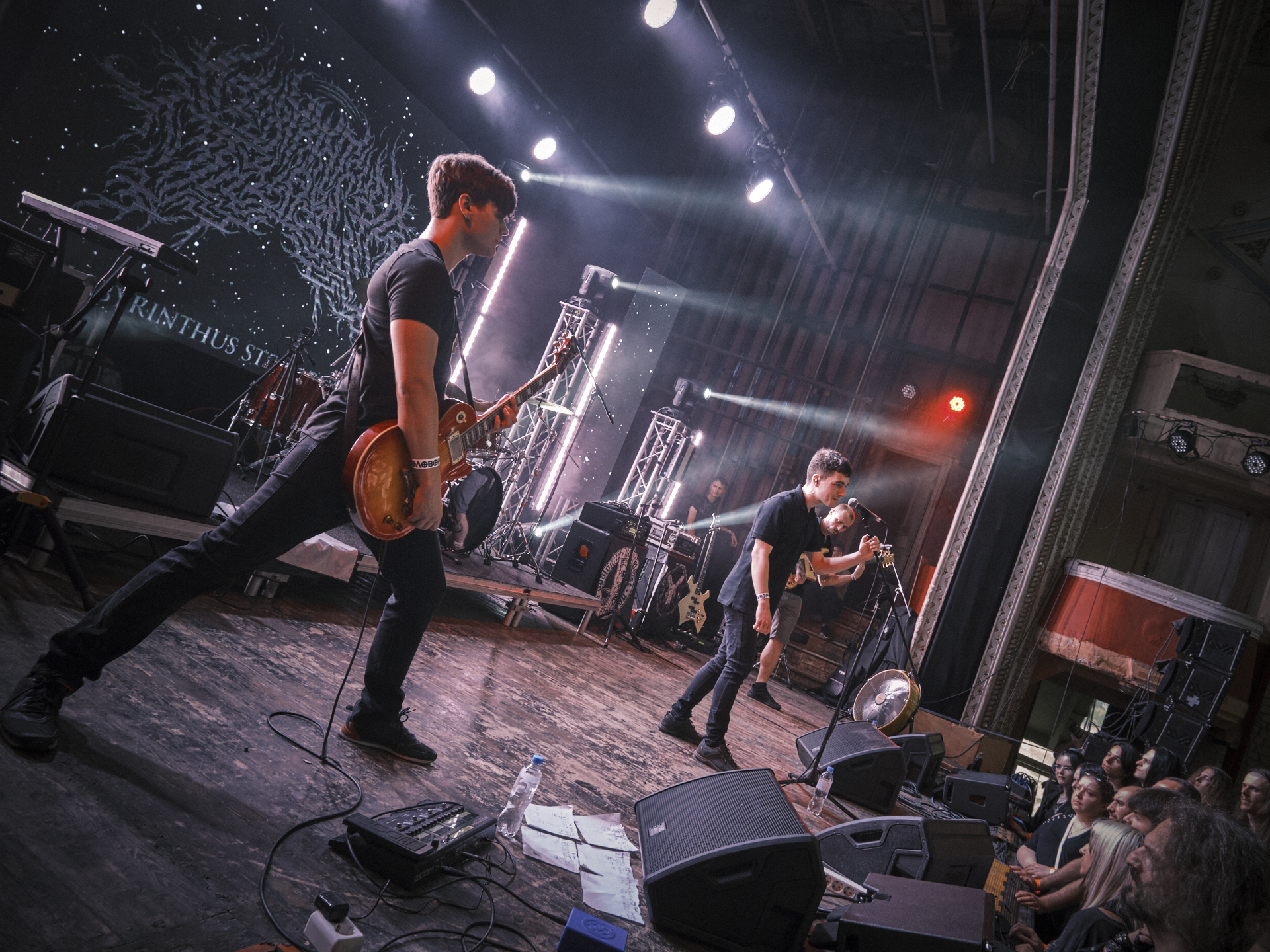
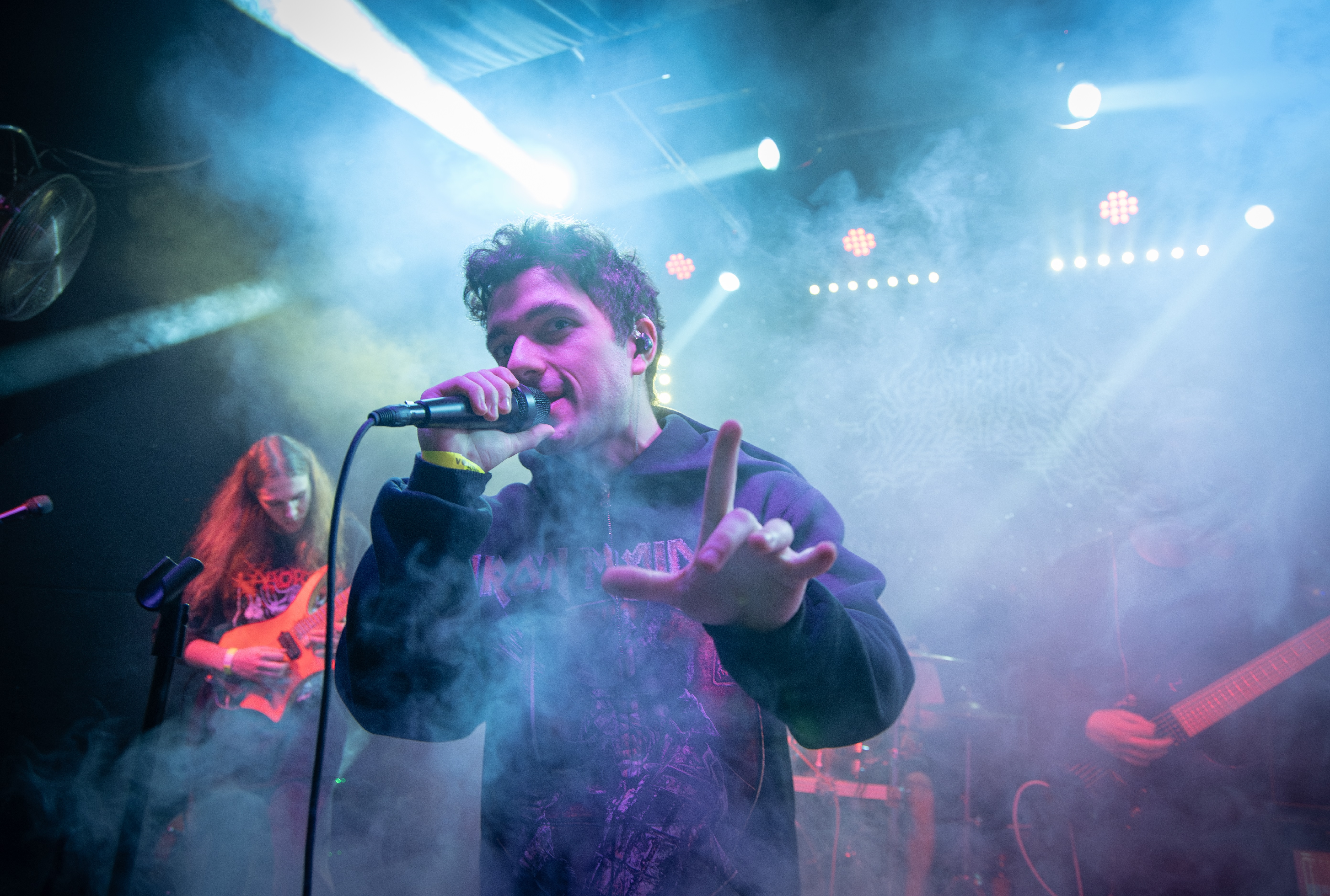
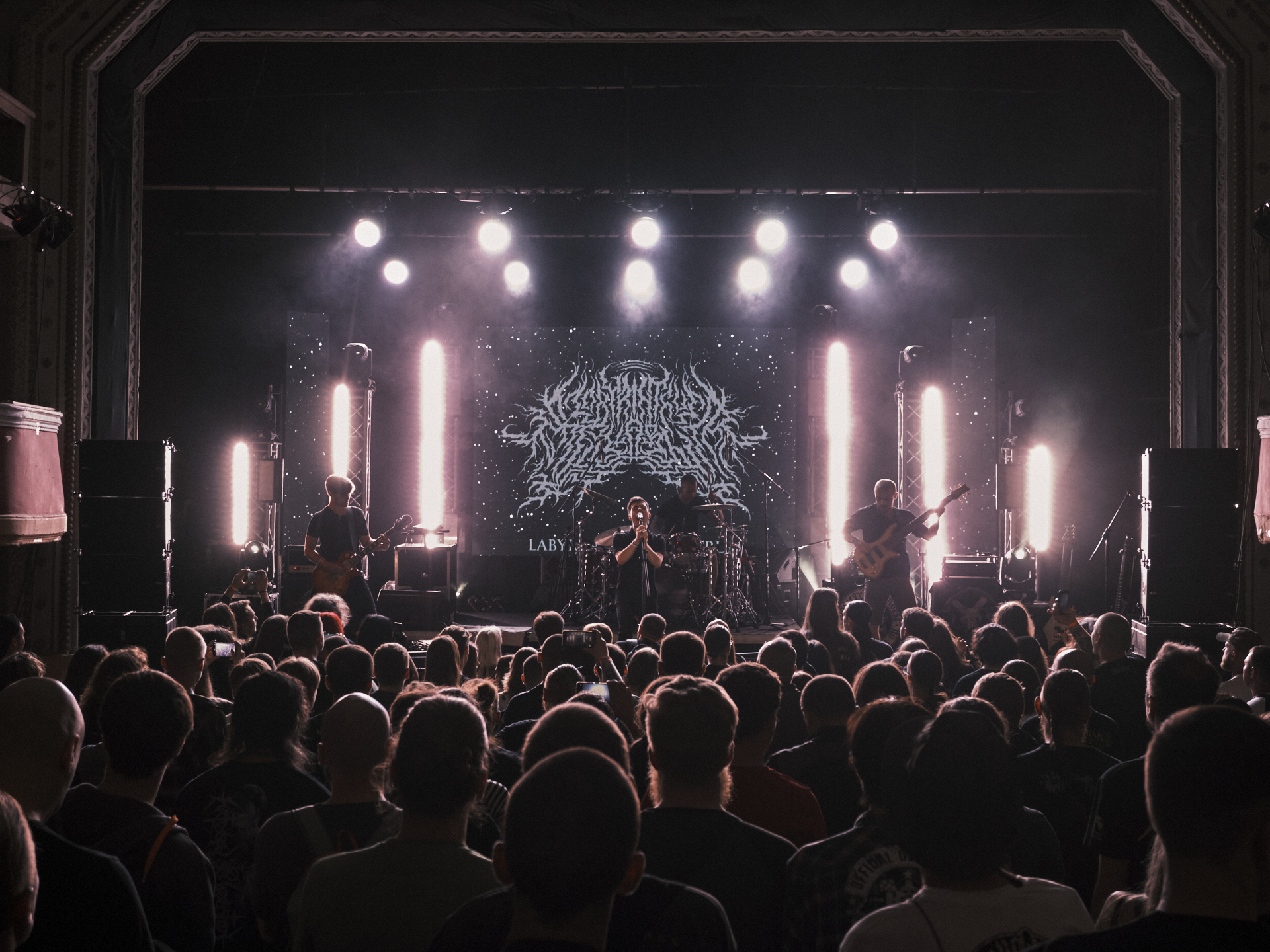
S: It seems at first you hadn't planned on performing live, but now you have a live lineup and a small Ukrainian tour behind you. How did that decision come about?
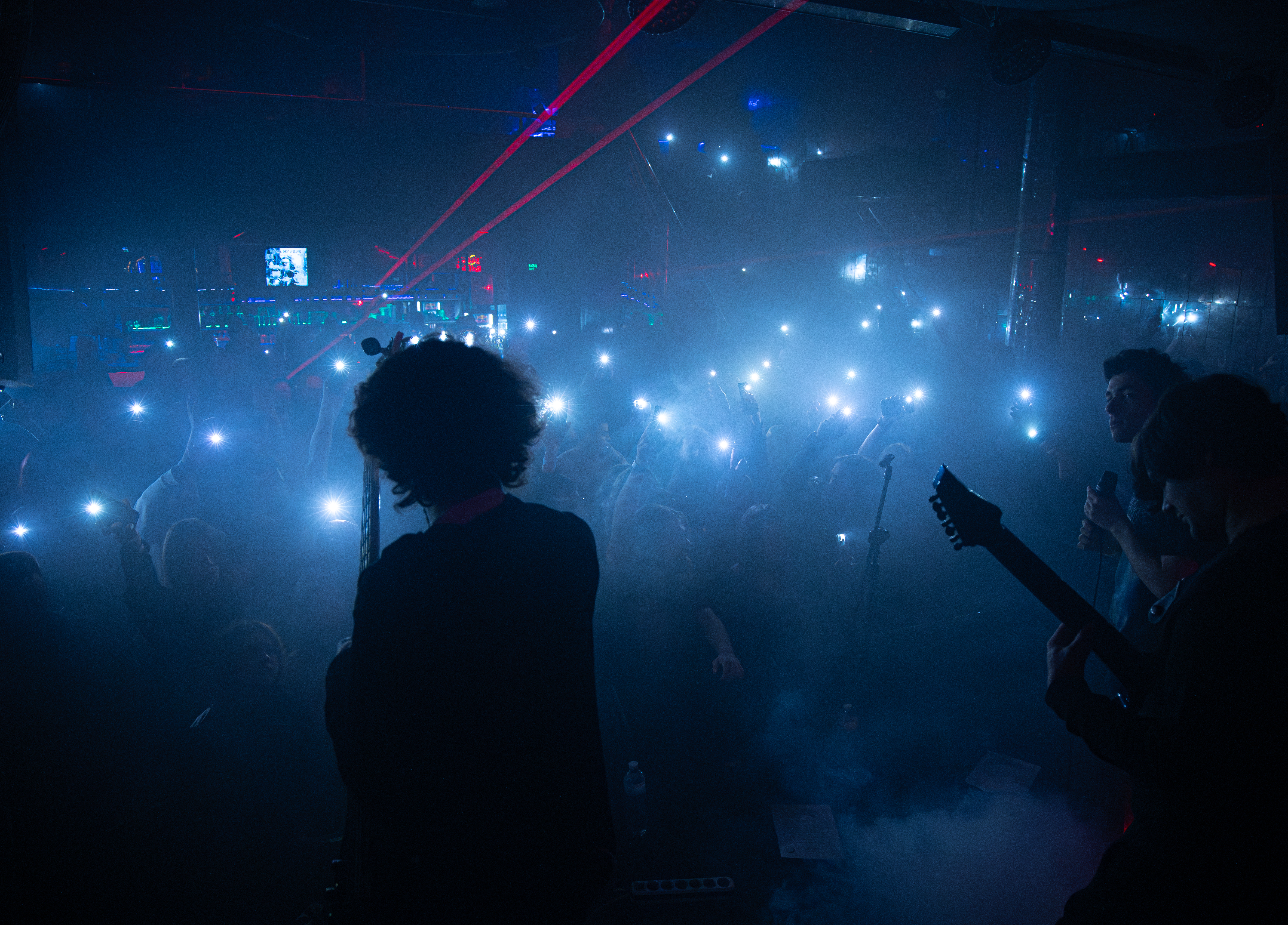
O: The desire was always there. Even ten years ago I was thinking: it would be great to have my own rock band and perform with them. But we didn't think there'd be demand for it. It all started because someone simply offered us a show. The first concert turned out to be in Kyiv — we were opening for NOKTURNAL MORTUM, and Archivist Records, who we work with on merch and CDs, helped organize it. An offer you couldn't refuse.
At that point we had zero live experience. The organizer wrote: "Want to play with NOKTURNAL MORTUM at the Mala Opera in two months?" We replied: "Seriously?!" We didn't even have a bassist. I hadn't even met the drummer yet, but I said: "Yes, we want to, we can, we'll make it happen!" [laughs]. And we did. Everyone loved it.
First gig — and straight away a big stage, the Mala Opera, 300 people in front of you. You walk out and think: "Wow" [laughs]. Of course, 95% of the audience had come for NOKTURNAL MORTUM, but after that people started coming for us too.
S: How did those people who came for classic black metal with folk influences receive your more modern sound?
O: Fine.
M: Back then it wasn't as modern as it is now. Tales of the Void is atmospheric black metal.
O: Right, you could still call it black metal back then. I wouldn't say that about Rift in Reality anymore — it's a mix of different genres where black metal might be just one element. I can no longer call it black metal: it's something else entirely.
S: You mentioned your Spotify stats. For an underground band — very serious numbers. Nearly a million streams on the most popular tracks, with Voyager sitting at around 800,000. Who handles the promotion and what's worked?
O: It was, I think, a bit outside of their usual format. But any kind of coverage brings additional audience, new people — and it all works like a snowball. It's not that any one specific thing gives you a fantastic result, but one thing after another.
M: Pretty much, yes. Most of the time we're not actively doing promotion. Sometimes we think: "There's a new song, we should do something" — and we do something. But it's not our main priority: we're musicians first.
And speaking of that feature — it's very hard to assess how any specific piece of coverage affects how many new listeners you get. We can track general trends — how much merch was sold in a month, how many streams on Spotify. But measuring the impact of a specific concert or publication — practically impossible.
O: Eventually Spotify starts recommending your music to other people on its own, and from there it develops organically — even without active promotion on our end.
Toronto TV episode about young Ukrainian metal bands
S: What's in store on the fourth album?
O: Overall there'll be even more variety. Some things will be heavier — with deathcore elements and growls. Others will be the opposite, even more accessible: clean vocals, danceable synths. Some tracks will even feature '80s-style synths — something like synthwave. A wide range. I look at it myself and think: "Does this even work as a single album? It's all so different." But we've always believed that variety is a strength, not a weakness. Even without a unified style, there are elements that tie everything together. We'll see how people receive the new direction.
S: Top three books and films?
O: Tough question. With books — I haven't read much in recent years; my favorites are mostly from my school years and first year of university. What comes to mind right away: Ender's Game — a very powerful book. And more broadly, science fiction: short stories by Sheckley, Bradbury, Isaac Asimov, Simak, Harry Harrison. There's a lot there, but picking three specific titles is hard.
With films, what comes to mind first: Interstellar, The Lord of the Rings — and then it gets harder.
M: I got into music early and it was my main focus, so I didn't read many books. Fully on board with Ender's Game — the first part. The second was less to my liking: less sci-fi, more inward-looking. I also really love how A Song of Ice and Fire is written — the series they adapted into Game of Thrones.
With films I'd name Shutter Island and Requiem for a Dream first. With series — Doctor Who: an inexhaustible source of sci-fi inspiration. And you can't leave out video games — we played a huge number of sci-fi games, but the main source of inspiration was definitely StarCraft — both the first and the second.
O: One hundred percent. StarCraft — number one.
M: The Holy Grail of sci-fi games.
S: If you could visit any place in space — real or imagined — what would it be?
M: A black hole.
O: The beautiful Pandora from Avatar — the nature there is incredible. Of all imaginary planets, it's one of the first that comes to mind. The artists created an extraordinary world. Maybe also some planet from Star Wars — I've loved them since childhood. Dune is also wonderful, but living in that desert — no. It's a depressing planet. I can appreciate the atmosphere, but I wouldn't want to end up there personally.
M: I'd also add the planet from the animated series Scavengers Reign — a very creative world, with predatory and parasitic flora and fauna, beautifully drawn. It's a shame the show was cancelled after the first season.
O: And Final Space — brilliant. Another series from the list of those cancelled before they could finish. The fact that Final Space is unfinished is a personal tragedy [laughs].
M: Fully agreed. Another tragedy will be if George R.R. Martin doesn't finish Game of Thrones.
O: He's not getting any younger. We're hoping he makes it.
S: Do you believe in the existence of extraterrestrial intelligence? And how do you think they'd receive LABYRINTHUS STELLARUM?
O: One hundred percent, something is out there. This universe is too vast to imagine that among millions and billions of star systems, life arose nowhere else. It exists somewhere — maybe very far away, maybe we'll never find out — but we can't be the only ones. The universe is too big.
How would they receive our music? That depends on how that life form is structured and how it thinks.
M: They'd destroy us for revealing state secrets [laughs].
O: I hope they'd enjoy it. I'd love to play a concert somewhere beyond Earth — on some space station, before an audience of aliens.
S: METALLICA became the first metal band to play in Antarctica. Maybe LABYRINTHUS STELLARUM will be the first to perform at least in Earth's orbit.
O: I'd love to, but honestly, I wouldn't survive the G-forces [laughs]. My health isn't what it was. Cosmonauts train for years. Today, only a highly trained, specifically conditioned person in excellent health can go to space.
M: Maybe technology will develop to the point where it's simply easier for ordinary people to be in space. Space tourism is already gradually becoming a reality for the very wealthy. We hope it becomes accessible to everyone else someday.
S: Final words for our interview?
O: Listen to good music, keep growing, make something great.
M: And peace above everyone's heads — to all. Peace. Everyone needs that peace so badly right now.
Video version of the interview: